SKR Provider
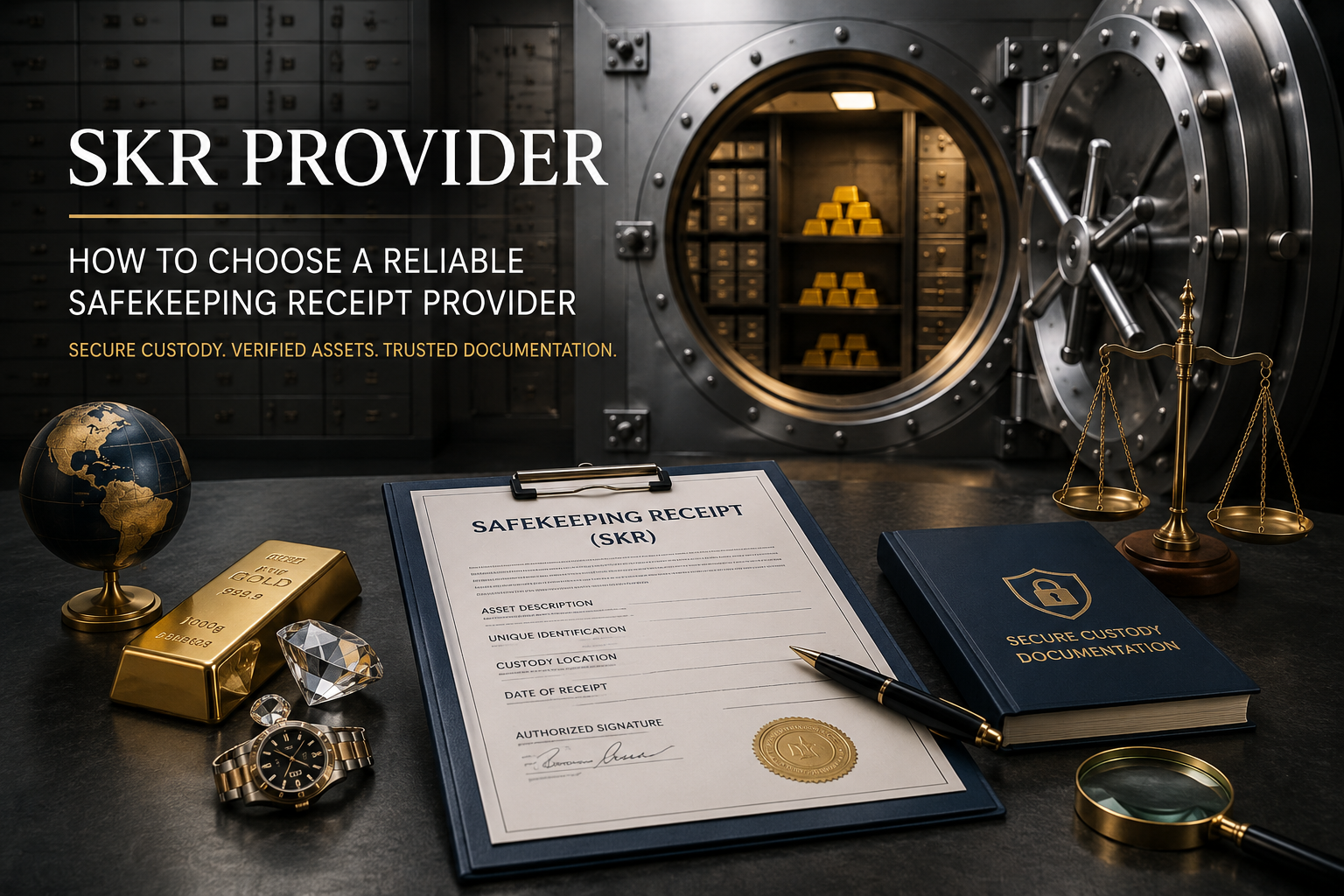
SKR Provider: How to Choose a Reliable Safekeeping Receipt Provider
What Is an SKR Provider?
An SKR provider is an organization that provides safekeeping and related documentation for qualifying assets under an established custody arrangement.
A Safekeeping Receipt generally documents that specified assets have been placed into a safekeeping or custody arrangement. Depending on the provider and asset, supporting documentation may include information about the asset, its identification, custody arrangements, valuation or evaluation, and other relevant records.
The exact legal meaning and practical use of an SKR can vary according to the asset, agreement, jurisdiction, and parties involved.
For this reason, an SKR should not automatically be treated as:
- A guarantee of asset value
- Proof that a bank will accept the asset
- A guaranteed financing instrument
- A substitute for legal ownership documentation
- A guarantee of investment returns
A reputable Safekeeping Receipt provider should clearly explain what its documentation represents and what it does not represent.
Why Choosing the Right SKR Provider Matters
The provider you choose can affect the quality of the documentation, the custody process, communication, due diligence, and the overall transparency of the arrangement.
For high-value assets, documentation errors or unclear custody arrangements can create significant problems later.
A reliable provider should be able to explain:
- What assets it accepts
- Where and how assets are held
- What documentation is required
- How assets are identified
- How evaluation or valuation is performed, when applicable
- Who is responsible for custody
- How the SKR is issued
- How documentation can be verified
- What fees apply
- What happens when the custody arrangement ends
The objective is not simply to find the cheapest SKR provider. The objective is to find a provider whose process, documentation, custody framework, and communication are appropriate for the asset and your intended purpose.
10 Things to Look for in a Reliable SKR Provider
1. Clear and Transparent SKR Process
One of the first things to evaluate is whether the provider can clearly explain its process.
A professional provider should be able to describe the major stages from initial inquiry through documentation and safekeeping.
Depending on the asset, this may include:
- Initial consultation
- Asset information review
- Documentation review
- Due diligence
- Asset evaluation or verification where applicable
- Custody arrangements
- Safekeeping documentation
- SKR issuance
- Record maintenance
- Ongoing communication
The exact process will vary according to the asset and service.
If a provider cannot clearly explain what happens to your asset or what documentation you will receive, ask additional questions before proceeding.
2. Experience With Your Type of Asset
Not every SKR provider is equally suited to every asset category.
A provider may work with certain types of tangible or documented assets while having limited experience with others.
Before selecting a provider, ask:
“Have you handled assets similar to mine?”
Depending on the provider’s capabilities, relevant assets may include:
- Gold and precious metals
- Jewelry
- Gemstones
- Fine art
- Collectibles
- Important documents
- Certain business or investment-related assets
- Other qualifying high-value assets
Global Trust Depository’s existing content discusses SKRs in connection with assets including precious metals, art, jewelry, documents, and mining-related assets.
However, asset eligibility should always be confirmed directly with the provider.
3. Strong Asset Documentation Requirements
Reliable safekeeping begins with accurate documentation.
Ask the provider what records are required to identify and evaluate the asset.
Depending on the asset, documentation could include:
- Ownership records
- Purchase documentation
- Serial numbers
- Certificates
- Appraisal or evaluation reports
- Assay documentation
- Photographs
- Legal documents
- Import or export records
- Chain-of-custody information
A provider that takes documentation seriously is generally better positioned to maintain accurate records.
You should also understand whether original documents, certified copies, or digital copies are required.
4. Transparent Custody Arrangements
One of the most important questions is:
Where is the asset actually being held?
Before signing an agreement, understand:
- The custody location
- Who controls access
- Who has responsibility for the asset
- Whether the asset is individually identified
- Whether assets are segregated or pooled
- How access is authorized
- What happens if the custody agreement ends
Do not rely solely on marketing language such as “secure,” “private,” or “institutional.”
Ask for practical information about the custody framework.
For example, a provider should be able to explain how an asset moves from the initial intake process into safekeeping and how its records are maintained afterward.
5. Verification and Due-Diligence Procedures
Due diligence is especially important when dealing with valuable assets.
Ask what procedures are used to verify the information supplied by the asset owner.
Depending on the asset, this could involve reviewing:
- Ownership documentation
- Asset identification
- Existing certificates
- Independent evaluations
- Assay reports
- Legal documentation
- Government records
- Supporting transaction documents
The purpose of due diligence is not simply to produce paperwork. It is to create a reliable documentary record that can be understood by the relevant parties.
A provider should be willing to explain what it verifies and what falls outside its responsibility.
6. Understand What the SKR Actually States
This is one of the most overlooked aspects of selecting an SKR provider.
Before accepting an SKR, carefully review what the document actually represents.
Ask:
- What asset is identified?
- Who is identified as the owner or depositor?
- What is the custody status?
- Where is the asset held?
- What date was the receipt issued?
- What supporting documentation exists?
- Does the document reference an evaluation?
- Who signs or authorizes the document?
- How can the document be verified?
Most importantly, understand the distinction between custody documentation, ownership documentation, valuation, and financing.
These concepts are not automatically interchangeable.
For example, an SKR should not automatically be represented as proof that a lender will accept an asset as collateral. Any financing decision is ultimately dependent on the relevant financial institution, transaction structure, legal documentation, jurisdiction, and its own due-diligence requirements.
7. Transparent Pricing and Fees
Price is an important consideration, but it should not be the only consideration.
Ask for a complete explanation of all expected charges before proceeding.
Potential costs may relate to:
- Initial assessment
- Documentation
- Evaluation
- Storage
- Insurance, if applicable
- Transportation
- Security
- Administrative services
- SKR issuance
- Renewal or extended custody
Ask whether fees are:
- One-time
- Monthly
- Annual
- Asset-value based
- Service based
A professional provider should be able to explain the fee structure clearly.
Be particularly cautious when a provider pressures you to make a payment before you understand exactly what service the payment covers.
8. Clear Terms and Written Agreements
Never rely solely on verbal promises when dealing with valuable assets.
The relationship between the asset owner and provider should be governed by clear written terms.
Review:
- Service description
- Custody terms
- Responsibilities of each party
- Fees
- Insurance provisions, if applicable
- Asset release procedures
- Termination provisions
- Liability provisions
- Dispute-resolution terms
- Applicable law and jurisdiction
If the agreement involves substantial assets or complex legal issues, independent legal advice may be appropriate.
9. Professional Communication and Verification
Communication is an underrated part of due diligence.
A reliable provider should be able to answer reasonable questions about:
- Its process
- Documentation
- Custody
- Fees
- Asset eligibility
- Verification
- Timelines
Be cautious when a provider:
- Refuses to explain its process
- Uses excessive pressure
- Makes extraordinary promises
- Avoids written agreements
- Gives inconsistent information
- Changes fees unexpectedly
- Claims guaranteed financial outcomes
A professional relationship should allow you enough time to review the documentation and make an informed decision.
10. Evaluate the Provider, Not Just the SKR
An SKR is only one component of the overall arrangement.
When evaluating an SKR provider, research the organization itself.
Look for:
Company Information
Verify that the business has identifiable contact information, a professional website, and clear information about its services.
Management and Expertise
Review the organization’s leadership and relevant professional experience where such information is publicly available.
Service Documentation
Look for clear explanations of the provider’s procedures rather than vague promises.
Independent Verification
Where appropriate, independently verify important claims before relying on them.
Reputation
Search for credible third-party information and consider both positive and negative evidence.
Legal and Financial Review
For high-value or complex transactions, consider having qualified professionals review the arrangement before signing.
Red Flags When Choosing an SKR Provider
The following warning signs should trigger additional due diligence.
Guaranteed Financing
Be cautious if a provider claims that an SKR automatically guarantees financing, loans, or investment capital.
An SKR does not by itself guarantee that a bank or other institution will accept an asset for financing.
Guaranteed Returns
An SKR provider should not need to promise investment returns simply to explain its custody or documentation services.
Extreme Urgency
Be cautious if someone says you must pay immediately or lose the opportunity.
High-value asset transactions deserve careful review.
Unclear Asset Custody
If you cannot determine where your asset will be held or who is responsible for it, ask for clarification before proceeding.
No Written Agreement
A significant custody arrangement should not depend entirely on verbal assurances.
Unexplained Fees
You should understand what you are paying for before transferring funds.
Unsupported Claims of Acceptance
Statements such as “every bank accepts our SKR” or “all lenders recognize this document” require independent verification.
SKR Provider vs. Storage Company: What’s the Difference?
A storage company primarily provides a physical location for storing assets.
An SKR provider may provide a broader combination of:
- Safekeeping
- Asset documentation
- Custody records
- Evaluation-related services
- Verification procedures
- Documentation issuance
However, the exact services vary between providers.
Therefore, do not assume that every company advertising storage provides SKRs or that every company offering SKRs provides identical custody services.
Ask the provider to explain exactly what is included.
Questions to Ask an SKR Provider Before Signing
Before selecting a provider, consider asking these questions:
- What types of assets do you accept?
- Where will my asset be held?
- Who has custody and control of the asset?
- How is my asset identified?
- What documentation do you require?
- What verification or due diligence do you perform?
- What exactly does the SKR document?
- How can the SKR be independently verified?
- What evaluation or valuation services are available?
- What are all the fees?
- Is insurance available or required?
- What happens when the custody arrangement ends?
- How is the asset released?
- What legal agreement governs the service?
- Which claims about the SKR should I independently verify with my bank, attorney, lender, or other professional?
These questions can help separate a transparent provider from one that relies primarily on marketing promises.
How to Compare Two SKR Providers
If you are considering multiple providers, create a simple comparison matrix.
| Factor | Provider A | Provider B |
|---|---|---|
| Asset type accepted | ✓ | ✓ |
| Clear custody location | ✓ | ? |
| Written agreement | ✓ | ✓ |
| Verification process | ✓ | ? |
| Transparent pricing | ✓ | ? |
| Asset documentation | ✓ | ✓ |
| Evaluation services | ✓ | ? |
| Release procedure | ✓ | ✓ |
| Professional communication | ✓ | ? |
The goal is not to choose the provider with the most impressive website.
The goal is to choose the provider whose process can be understood, documented, and independently evaluated.
Why Global Trust Depository?
Global Trust Depository provides services related to asset safekeeping, documentation, private vault storage, bonded courier services, evaluation reports, and Safekeeping Receipts.
Its published materials describe SKR-related services for various categories of assets and emphasize documentation and safekeeping as part of broader asset-management services.
For asset owners considering an SKR, the appropriate starting point is to discuss the asset, documentation, custody requirements, and intended use of the documentation.
The important question is not simply:
“Can I get an SKR?”
It is:
“What type of safekeeping and documentation arrangement is appropriate for my asset and objective?”
That distinction can make the evaluation process much more useful.
Frequently Asked Questions About SKR Providers
What is an SKR provider?
An SKR provider is an organization that provides safekeeping arrangements and related documentation for qualifying assets. The specific services, custody arrangements, and documentation provided vary by organization and asset type.
How do I choose a reliable SKR provider?
Compare the provider’s asset experience, custody arrangements, documentation process, verification procedures, fees, written agreements, communication, and reputation. Do not choose solely on price.
What should I verify before using an SKR provider?
Verify the provider’s identity, custody arrangements, documentation requirements, fees, contractual terms, asset eligibility, and the exact meaning and intended use of the SKR.
Can an SKR guarantee financing?
No. An SKR should not automatically be represented as a guarantee of financing. Whether an institution accepts an asset or related documentation depends on its own requirements, due diligence, legal framework, and transaction terms.
Does an SKR prove ownership?
An SKR can document a safekeeping arrangement, but the relationship between an SKR and legal ownership depends on the specific document, asset, custody arrangement, and applicable law. Ownership should be established through appropriate legal and asset documentation.
Can gold be placed under an SKR?
Some providers offer safekeeping and documentation services for gold and other precious metals. Asset eligibility, identification, evaluation, storage, and documentation requirements should be confirmed directly with the provider.
How much does an SKR cost?
There is no universal SKR price. Costs can depend on the asset, custody requirements, evaluation, storage period, transportation, insurance, documentation, and other services.
Can an SKR be used internationally?
The practical use of an SKR across borders depends on the parties involved, jurisdiction, asset, documentation, and the requirements of the institution or transaction involved. International use should therefore be independently verified.
Final Checklist: Choosing an SKR Provider
Before signing an agreement, make sure you can answer:
- What exactly is being held?
- Where is it being held?
- Who has custody?
- What documentation identifies the asset?
- What does the SKR actually certify?
- What verification is available?
- What are the total fees?
- What are the release conditions?
- What happens if the agreement ends?
- Have important claims been independently verified?
- Have you obtained professional advice where necessary?
A reliable Safekeeping Receipt provider should make these questions easier to answer—not harder.
Choosing an SKR provider requires more than comparing prices or searching for the provider making the biggest promises.
A stronger approach is to evaluate the complete arrangement: asset eligibility, documentation, custody, verification, contractual terms, fees, communication, and the actual purpose of the SKR.
For valuable assets, transparency matters.
Global Trust Depository offers SKR and related asset-management services for qualifying assets. If you are considering a Safekeeping Receipt, the next step is to discuss your asset and requirements with the provider and determine what documentation and custody arrangement are appropriate for your situation.
Learn more about Safekeeping Receipt and asset-management services from Global Trust Depository and discuss your requirements with its team.